GI: Paedatric Pathology Case 2
A newborn presents with respiratory distress soon after birth.
Chest X-ray reveals bowel loops in the left chest and mediastinal shift.
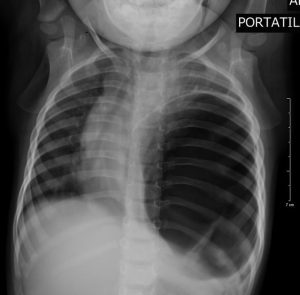
https://radiopaedia.org/articles/bochdalek-hernia
Congenital diaphragmatic hernia (Bochdalek hernia – see below)
This is caused by the failure of the pleuroperitoneal membrane to fuse
Classification of Diaphragmatic Hernias
| Category | Type | Subtype | Key Features |
| Congenital | Bochdalek Hernia | — | ~90% of Congenital Diaphragmatic Hernias ; postero-lateral defect; predominantly left-sided; impairs fetal lung development (pulmonary hypoplasia) |
| Congenital | Morgagni Hernia | — | Anterior defect; rarely detected antenatally; less severe respiratory impact in infants |
| Congenital | Central Tendon Defect | — | Very rare; defect in the central tendon of the diaphragm |
| Acquired | Traumatic | — | Blunt force (e.g. RTA) or penetrating injury (e.g. stab wound) causing diaphragmatic rupture |
| Acquired | Hiatal Hernia | Sliding (Type I) | GOJ and stomach slide superiorly through the oesophageal hiatus; most common type |
| Acquired | Hiatal Hernia | Paraesophageal (Types II–IV) | GOJ remains in situ; portion of stomach herniates alongside oesophagus; Types III/IV involve increasing gastric herniation |
| Acquired | Iatrogenic | — | Post-surgical diaphragmatic defect, typically following thoracic or upper abdominal procedures (e.g. oesophagectomy, fundoplication) |
Robbin’s: Page 686