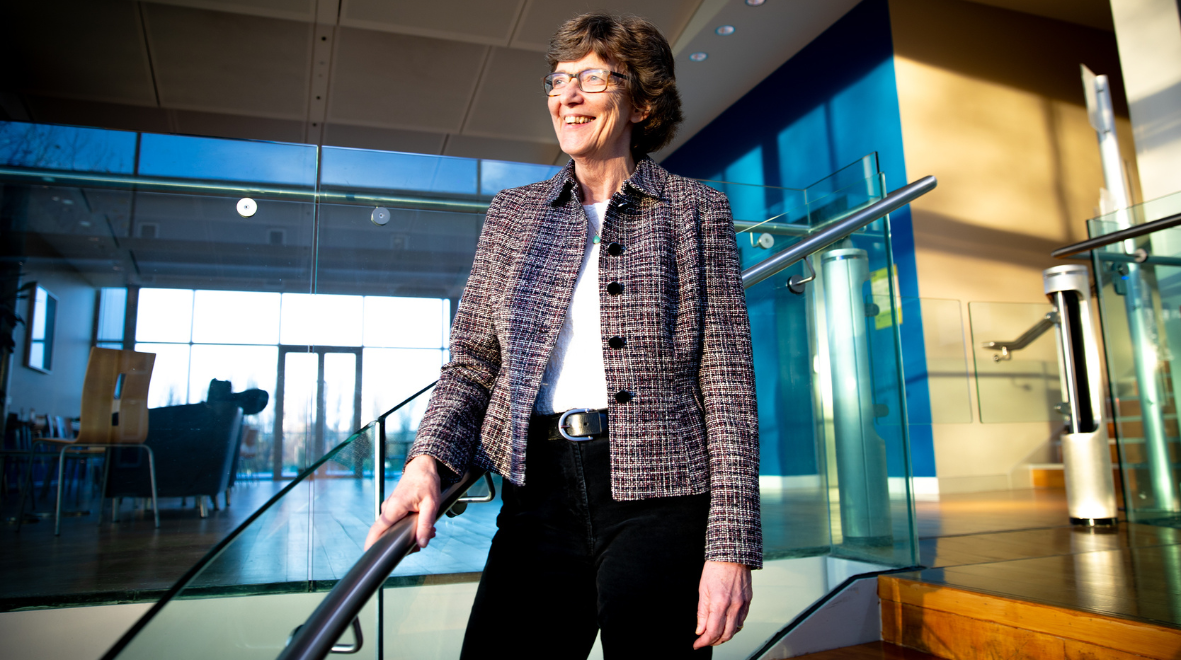
This festive period, Three Wise Women from the Faculty of Medicine give us the gift of wisdom.
Professor Anne Lingford-Hughes, Professor of Addiction Biology and previously Head of Division of Psychiatry in the Department of Brain Sciences, reflects on the journey that led her to become one of the UK’s leading experts in addiction psychiatry. From early uncertainty about medicine to pivotal moments in research labs in Cambridge and the US, she describes how scientific curiosity – and a fascination with how alcohol and drugs affect the brain – shaped a career dedicated to understanding and treating addiction.
Brought up in the countryside outside Shrewsbury, I was always interested in science and loved doing school projects. I wasn’t seen as particularly clever at school and was even advised that I didn’t need a “career” – just a job until I got married!
The only interesting university course covering “human biology” was medicine. Although I wasn’t sure about becoming a doctor, I applied. My father, a lawyer who had been to Oxford like his own father, wanted me to go there too, but my school was not exactly encouraging. I applied anyway and failed.
Refusing to give up, I moved to another school – Shrewsbury, which was all boys at the time, apart from me – for one term to retake the Oxford entrance exams. This time I was much better prepared, won a place, and began studying medicine in 1980.
It was the first of many moments showing me how important the right guidance and preparation are – and how much more you can learn from failure than success.
Discovering research – and the brain
Still unsure about clinical medicine, I accepted a PhD position offered by my final-year project supervisor and moved to Cambridge. My PhD involved characterising the CCK receptor in the brain in animal models – essentially studying how certain brain signaling systems work.
By the end of my PhD I was still unsure about completing my clinical training so I went to the National Institutes of Mental Health (NIMH) in the USA for a two-year postdoc. Two key things happened there that changed everything.
First, some lab members were psychiatrists who would pop in with blood samples or central spinal fluid samples from patients on the ward. I became fascinated by the patients’ stories and how research could help to understand and treat their conditions. So, I decided to return to the UK to complete my clinical training to become a psychiatrist.
Second, I joined a team studying the GABA-benzodiazepine receptor – the brain’s main inhibitory system – and how it mediates the effects of alcohol and barbiturates in animal models. Several years later, while training as a psychiatrist, I was awarded a Wellcome Trust clinical fellowship (after two attempts!) to study this same receptor in alcoholism, this time in people, using brain imaging (single photon emission tomography).
This fellowship was pivotal: it let me build on my preclinical experience and translate into clinical work – a balance I have maintained ever since.
Finding addiction psychiatry
I trained at the Maudsley & Bethlem Royal hospitals, linked to the Institute of Psychiatry (IOP). My supervisors were hugely influential. Professor Rob Kerwin, a world-leading psychopharmacologist, drilled into me the importance of having a clear hypothesis –without one, you can’t design the study. It is still a guiding principle and one I instill in my own students and look for when reviewing papers or grants. My other supervisor, Dr Jane Marshall, a leading psychiatrist in alcoholism, supported my developing interest in addiction. So much so, I switched from training in old-age psychiatry to addiction psychiatry and have never regretted it. I love the mix: neuropharmacology, medicine, and the social and environmental factors that shape addiction.
Serendipity, networking and joining Professor David Nutt’s group
Although the IOP gave me lots of opportunities, there was limited research into the neuropharmacology of addiction. At a conference poster session, I discussed my early data from my imaging work with Dr Andrea Malizia, who worked with Professor David Nutt. I knew David from medical school, and we overlapped at NIMH – but I didn’t realise he had just secured an MRC programme grant to study neurobiology in addiction with PET imaging. He was looking for researchers, and I joined him soon afterwards. We’ve worked together ever since.
This experience taught me the enormous value of attending conferences and talking to people – you never know where a conversation will lead. I’ve always encouraged and supported my students and postdocs to go for exactly that reason.
Years of imaging, moving cities and balancing family life
I began working on the PET programme at Hammersmith in 1997 and have done my imaging here ever since – almost 30 years! I joined David’s group at University of Bristol as a Clinical Senior Lecturer in 2000, while also the Consultant of the alcohol service, but continued travelling back to London for imaging studies.
I loved living near the countryside again after so long in London. In 2009, I became Professor of Addiction Biology at Imperial and joined CNWL NHS Foundation Trust for clinical work. I still live in Bristol, so the commute – and often living away from my family – has been very challenging. But the opportunities and flexibility to work from home (even pre-Teams and Zoom!) have made it worthwhile.
None of this would have been possible without my husband – or “domestic CEO” as he calls himself on LinkedIn – and my daughter, who put up with my absences. I have always tried to be there for important moments like school plays, and they often travelled with me to conferences. We adopted our daughter when I was in my 40s, which, with a more established career, made taking time out less daunting.
My daughter is a keen equestrian competing on the British Eventing circuit, so most weekends I’m in a field or driving a horse lorry to a competition. I have even joined an ethics committee from the horse lorry! When I recently asked if she felt she’d missed out because of my work, she said no – she got to travel, I was always there for her riding, and she quite likes that her friends are “a bit impressed” by what I do.
Advancing the science of addiction
Over the last 30 years, our team’s neuroimaging studies (PET and fMRI) have helped characterise the neurobiology of addiction, particularly alcohol and opioid dependence.
Working with Dr Louise Paterson, and using strong preclinical evidence, our team has shown that compounds such as NK1 or DRD3 antagonists may help prevent relapse by attenuating dysregulated brain responses in reward system or to triggers like drug cues or emotional stress.
More recently, we’ve run proof-of-concept clinical trials, including a study testing whether baclofen helps people detox from methadone in opioid dependence. Conducting trials in addiction services, many of which are now outside the NHS, has been challenging but has created valuable learning for future community-based research.
Crucially, we have always worked closely with people with lived experience. It’s encouraging that their input and involvement is increasingly recognised as essential by funders and institutions.
Teaching, leadership and an unexpected move into policy
Teaching undergraduates and postgraduates has been one of the most rewarding parts of my career. I’ve always tried to create opportunities for others, whether locally or through national career development panels. Seeing people grow and succeed is a real joy for me.
I’ve also held several leadership roles, including recently being Head of Psychiatry at Imperial. I never set out to be a “leader”, but I realised early on that if you want to change things, you need to be in the driving seat. Sitting on national and international committees taught me a great deal about effective leadership.
More unexpectedly, I was appointed Chair of the Addiction Healthcare Goals at the Office for Life Sciences (OLS). The Goals programmes aim to improve research infrastructure across major health areas so to innovations can reach the clinic faster. I had never done Government or policy work before, so it has been a steep learning curve – but immensely rewarding. I work with a great team at OLS, and we’ve delivered, for example, major funding calls and career development fellowships.
Looking back – and forward
Throughout my career, I have been fortunate to work with many wonderful colleagues and to travel to extraordinary places. Being part of a supportive team has always mattered to me – it makes the highs and lows easier.
My hope is that the evidence we’ve generated will help transform how we treat addiction. That transformation is long overdue.