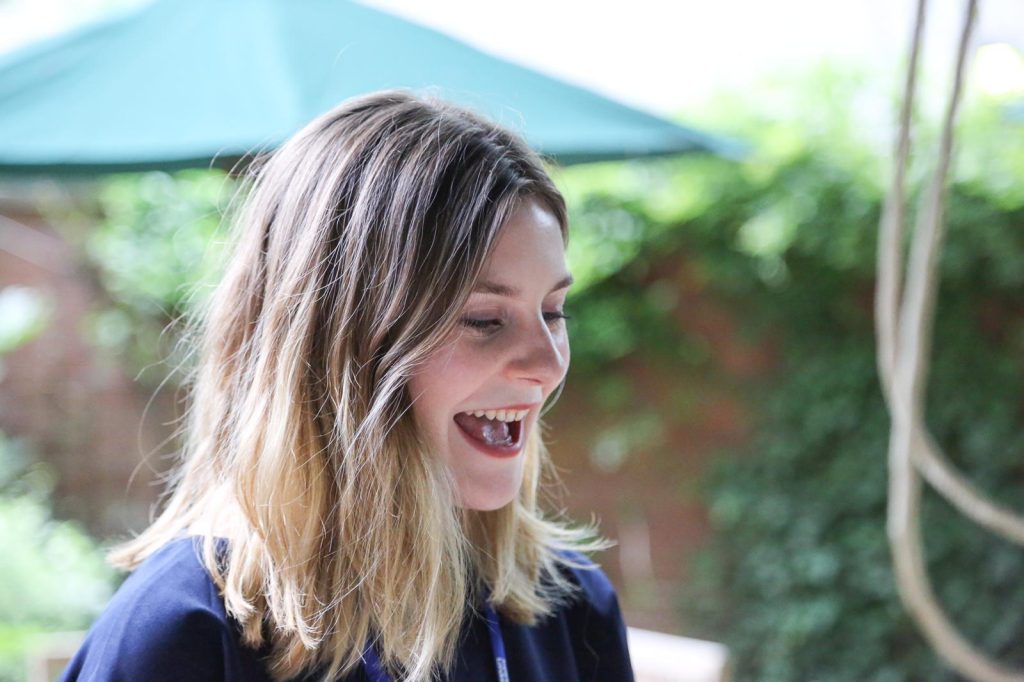
“My involvement in StudentShapers helped me develop time management, project management and teamworking skills.”
Georgia Simmons is a postdoctoral researcher in cancer biology at Imperial. She completed her postgraduate studies at Imperial, including an MRes in Cancer Biology and an MRC-AstraZeneca funded PhD.
From Portsmouth to Imperial
Georgia’s academic path began with a BSc in Biomedical Science at the University of Portsmouth, where a three-month ERASMUS placement at the Nencki Institute in Warsaw first sparked her interest in cancer biology and influenced her decision to pursue a career in cancer biology.
Imperial’s MRes in Cancer Biology was Georgia’s first choice. She said: “The opportunity to undertake two separate research projects was particularly appealing, as it allowed me to gain a diverse range of technical skills while developing in‑depth knowledge of cancer biology.” Imperial College London’s reputation as a world‑class institution further influenced her decision.
Her MRes research contributed to a published paper and led to an invitation to apply for a PhD position in the same lab, funded by AstraZeneca.
Shaping the student experience
During her MRes degree, Georgia worked part-time and took on teaching roles. Through this she became involved in the StudentShapers programme, which offers students the opportunity to undertake projects in partnership with staff to improve the learning and teaching experience at Imperial.
As part of this programme, Georgia helped shape the Attributes and Aspirations course which helps student develop transferable skills and plan for their career following graduation. She collaborated with Teaching Fellows and other students to determine the course content, based on educational research and personal experience.
She says the experience helped her develop skills which supported her own academic career. “My involvement in StudentShapers helped me develop time management, project management and teamworking skills.
“It also encouraged me to consider the bigger picture of my career and set milestones for myself.
She recommends that other students fully immerse themselves in the course. “It’s the culmination of many student experiences, combined with expertise from skills staff members, and designed to make your educational career easier.
“In particular, I valued the tailored advice which supports students through the transition from undergraduate to postgraduate studies. It’s a significant change which people often forget, and this course was a really helpful as a guide through it.”
Research collaboration and learning from others
Georgia is now part of an ambitious postdoctoral research project funded by AstraZeneca. Her work focuses on expanding and characterising an engineered cell line panel of estrogen receptor mutations, with the aim of generating evidence to support the consideration of rarer activating mutations in future breast cancer clinical trials.
She said: “I really enjoy the collaboration aspect of my work and being able to learn from others. I want to keep pushing myself, taking on more teaching, building networks, and preparing for the next stage of my career. One day, I’d love to do a postdoc abroad and combine research with experiencing new cultures.”
Finding balance
Outside the lab, Georgia finds joy in gardening, yoga, reading, and spending time with loved ones. “Research is a big part of my life, but these things help me stay balanced.”