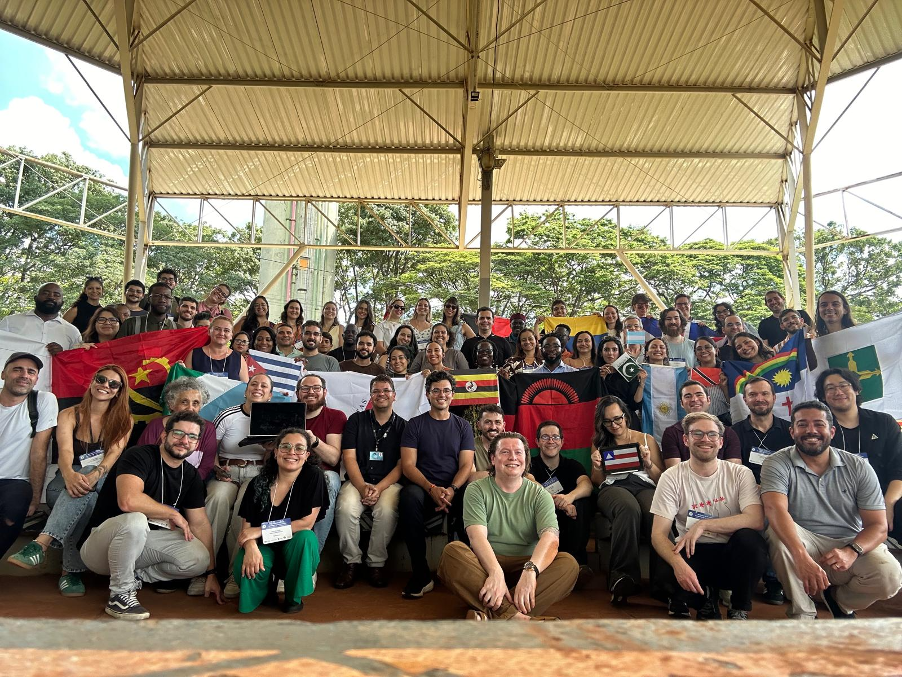
Tabassum Iqbal from the School of Public Health reflects on the Genomic Epidemiology of Arboviruses Workshop held in Campinas, Brazil. Bringing together researchers from across the globe, the programme combined hands-on training with expert insight – building skills, fostering collaboration and supporting those working on the front line of emerging infectious diseases.
Expecting the unexpected
“Throughout my career working in the epidemiology of arboviruses, I’ve learned that the only thing you can truly predict is the unpredictable.”
These were the words Professor Nuno Faria used to open the first talk of the Genomic Epidemiology of Arboviruses Workshop, organised by Dr Darlan da Silva Candido from the School of Public Health and Jose Modena at the Universidade Estadual de Campinas.
Five days, 50 in-person participants from 13 countries, and 35 speakers and course convenors – it was ambitious, to say the least, and a huge undertaking for the organising committee and support team.
Why arboviruses and why now?
Arboviruses are viruses transmitted by insects such as mosquitoes and ticks, and include diseases like dengue, Zika and chikungunya. They represent a major and growing public health challenge, particularly in Latin America, where millions of cases are reported each year.
Outbreaks are often difficult to detect and track due to overlapping symptoms and the co-circulation of multiple viruses. In recent years, genomic epidemiology – using viral genetic data alongside traditional public health information – has become a powerful tool for understanding how these viruses spread and evolve.
This workshop, held in February 2026 at UNICAMP, was designed to strengthen capacity in this rapidly advancing field. By bringing together researchers, public health professionals and policymakers, it aimed to equip participants with practical skills while fostering long-term national and international collaborations.
Opening doors for global participation
Thanks to the generous support of the MRC GIDA pump-prime fund, we were able to fully cover travel, accommodation, transfers, visas and meals for all participants.
This made the course accessible to colleagues from communities most affected by arboviruses, and to those who would benefit most from building capacity within their own institutions. Creating this inclusive, diverse environment was central to the spirit and success of the course.
Supporting travel for such a large group across five continents was no small task. It involved building a website, booking flights and accommodation, and arranging payments – and navigating a major last-minute challenge that required a complete pivot in location and organising partner just as we were ready to go live.
After numerous flight changes to avoid storms, extended airport stays, and a fair amount of “airport herding”, everyone arrived safely and on time for the launch of the workshop.
From theory to practice
The programme was wide-ranging and hands-on. It combined talks from world experts – including global policy makers, leading researchers and industry partners such as WHO, PAHO and the Brazilian Ministry of Health – with lab practicals in genomic sequencing, tutorials on bioinformatics and phylogenetics, and group work and presentations.
Where possible, sessions were opened to online participants, and translation support allowed speakers to present in their native Portuguese, helping make the course more inclusive and accessible.
A week of learning
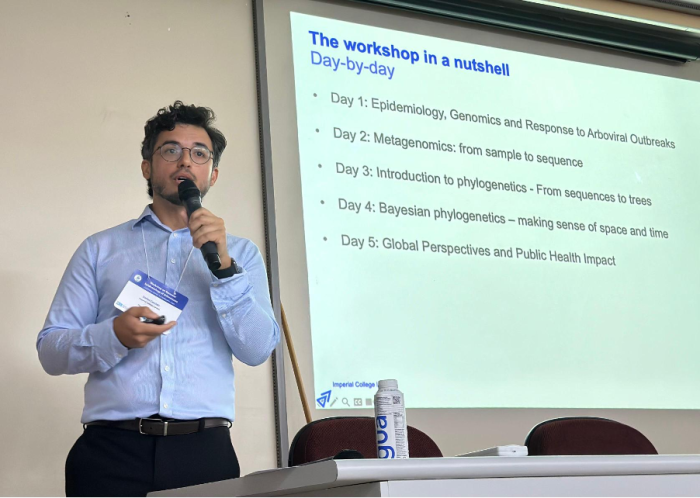
Each day built on the last.
Day one explored key challenges and opportunities in the field, with topics ranging from “Investigation into sylvatic yellow fever in Southeast Brazil” to “AI approaches for understanding arbovirus biology”.
Day two shifted to practical learning, with sessions on “Metagenomic and targeted sequencing for outbreak response” followed by hands-on lab work.
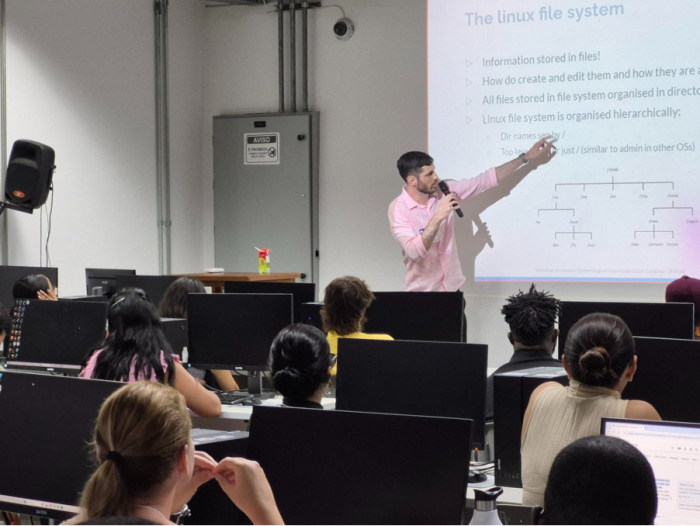
Day three moved into the computer lab, with “An introduction to phylogenetics: From sequences to trees” alongside group analysis of real data sets.
Day four continued this work, focusing on “Bayesian phylodynamic and how to interpret patterns across time and space”.
Day five brought the week to a close with participant presentations and discussions on global public health impact, followed by emotional goodbyes and a final scramble to get everyone onto the right airport transfers.
Powered by curiosity
The days were long, but consistently engaging. Participants were driven by a genuine desire to learn – fuelled by plenty of coffee and Pão de queijo (a popular Brazilian cheese ball snack!).
The poster session, which ran into the evening on day two despite heavy rain, was a particular highlight. It gave participants the chance to share their work, exchange expertise and learn from each other’s experiences.
One of my favourite moments was the final dinner, where poster prize winners were announces. It was a genuinely emotional occasion, with winners recognised by external experts and offered encouragement and support.
As one winner, Layla Honorato, shared:
“This workshop meant a lot to me because it brought together professionals whose work has always inspired me, and being able to learn from them in person was truly meaningful. Beyond the technical learning, the cultural exchange with people from different backgrounds reminded me that science for health is one of the strongest things that connects us all. Receiving the award was honestly emotional for me, because it felt like a reminder that I’m capable and that I’m on the right path”.
Reflections and impact
I was incredibly grateful to be invited to take part – engaging with stakeholders, exploring potential collaborations, and helping keep the programme running smoothly (troubleshooting online connections was almost a full-time job in itself!)
It was a valuable opportunity to be involved in such a hands-on, large-scale workshop, and a useful refresher in both teaching and logistics. I came away with a much clearer sense of what works well – and what doesn’t – which will be invaluable in improving the design and delivery of future workshops as part of the Vaccine Epidemiology Research Group’s (VERG) activities.
Meeting and learning from so many motivated and passionate individuals was deeply inspiring. Six thousand miles from home, in a climate twenty degrees warmer than the one I had left, I was struck by an overwhelming sense of calm and belonging.
The shared enthusiasm and common goals across the scientific community are a powerful reminder that “we have more in common than that which divides us,” and offer a sense of hope in a political climate that sometimes offers very little.
A collective effort
Muito obrigada to everyone involved – from those delivering teaching and preparing materials, to those working behind the scenes booking travel, coordinating the logistics and keeping everything on track. It was truly a collaborative effort.
And congratulations to Darlan and the wider organising committee on delivering such a successful workshop – hopefully the first of many to come.
“What an incredible week! Both challenging and deeply rewarding from start to finish. Co-leading this workshop pushed me in new ways, and seeing ideas turn into real collaboration around genomic epidemiology was truly powerful. Participants have now returned to 13 countries, carrying these tools and connections forward to strengthen the global impact of genomic epidemiology. I left energised and looking forward to the next one!” – Dr Darlan da Silva Candido