Category: Teaching

Departments: Electrical and Electronic Engineering
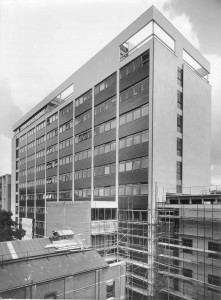
Electrical Engineering 1962
Electrical Engineering in 1962

It’s not until you start to look at individual tapes in our archive that you realise how many different videos have, or could have, a link between them.  In this latest blog I’ve found an example of that with two research videos made for the Electrical and Electronic Engineering Department ( Electrical Engineering Department as it was when these were made). We’ll also be seeing something of the actual department from the past. I should also point out that until 1976 were part of that department (a departmental facility) and as such located within the building. Our first location was on the 3rd floor moving to the main walkway level 2, where many of you may remember us.

In February 1981 Professor J.C Anderson (“Andy” Anderson 1922-2001) asked me to make a video showcasing the research in his Electrical Materials section within the department.  I can’t recall the exact reason why we made the video, but am assuming it was to do with an open day, or similar, for Postgraduate research students, hence his references to getting PhD’s at the end of the video. The research going on at that time is shown and he makes reference to the work by Mino Green on Electrochromic Displays, but more on that in a moment.

Andy was very keen on the use of modern technologies for teaching, research and promotion and was the Chairman of the “Educational Technology Committee” (long since disbanded). It was his idea that I should be the only non-academic (although I was on the ‘academic related staff’) member of that committee to be able to update and advise on matters relating to the use of video within Imperial. He was not afraid to appear in front of the camera or, as in this case, record a voice-over as well. So here is the video we made with him: “Electrical Materials Research at Imperial College”

In the previous video, mention was made of the work by Professor Mino Green (1927-2022) (then Dr) on Electrochromic Displays. This work was already being carried out at the time of the previous recording. In fact the first video on Electrochromic Displays was made a year earlier in April 1980. We made some 7 videos on the subject with the last being in March 1993. I gather that Professor Green’s work has now moved away from such devices, but the concept was interesting and novel. The video itself is an example of how to show large numbers of people the research work being carried out by a small dedicated group. Even as long ago as 1980 we were having copies made into the American NTSC TV system to enable research work to be showcased in the USA, Mino Green’s was an example of this. Here is the video from 1993 on “Electrochromic Displays and Windows”.

Mino was an Emeritus Professor of the Science of Electrical Devices. His webpage described his work as “…The interplay of solid state physics and chemistry, particularly physical chemistry, has been an abiding interest. This has led through many areas, including semiconductor electrochemistry, chem- and physi-sorption on semiconductors, thermoelectric systems, solid state photo-and e-beam-decomposition, and transition metal oxide electrochromic systems. Now my main interests are in the larger end of nano-systems…”. In 1980 STOIC recorded an interview with Mino where he explains his area of research, you can see that video above.
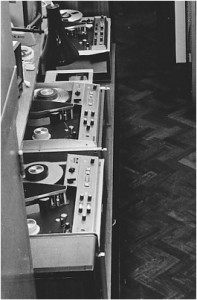
Ampex Video Recorders
Ampex Video Recorders in use in TV Studio number 2

Finally for this particular blog I’ve pulled something out of the archive from 1978 and you’ll see that in just a moment. It was a video made to showcase the whole department rather than a particular division or research project. Again, I can’t recall the exact reason why we were asked to make the video, but assume it was either an open day or event with alumni for example. Open day is more likely as the video is dated June 1978. It was a major task to make too, as editing was primitive on our old Ampex open spool one-inch tape machines. Nothing was automatic and edit points were marked with white (‘chinagraph’) wax pencils onto the tapes directly, spooled back and then run up to speed for editing. Recently I re-discovered a tape, made in 1974, where we are showing what the studio could do. So, before we see that 1978 video, here I am in our original TV Studio number 1, showing briefly the Ampex recorder in use, which I can assure you was as heavy as it looked!

At this time, we had no real means to record outside of the studio. One option though was to link from a location back to the studio by cable. And, because we were located in the Electrical Engineering, the whole building had video cables running from the ground, to top floors. We then had the ability to run from a location point on each main floor, down to the studio and potentially elsewhere. In the end, cables were available to and from many different buildings around the South Kensington campus. However, by this time we had already gained the ability to record outside of the studio having just moved into colour operation on the U-matic tape format. Portable battery operation was then made possible. The video that follows is an example of this.

So back then to the video I made for Electrical Engineering . The video did require a voice-over, but could I get anyone to volunteer to record it for me? Well the answer was no and being at a stage of needing to start the editing I had to do it myself. That aside, the video is a unique record of the department showing its teaching and facilities. I was asked to make specific reference to the fact that every lecture room was equipped with an ‘overhead projector’, how times have changed! The department also had its own glassblower, electronics servicing and draftsman. Here then is a snapshot (in black and white) of the department as it was in the early summer of 1978.

Colin Grimshaw May 2010
Promotion: 1 – Imperial College

In one way or another, ever since we’ve had the use of video as a medium we have used it to promote things. You will have already seen in other posts the promotion of specific research projects or research groups and so on. But we’re going to start another series that shows how we’ve tried to promote the college as a whole. I’ll also mention that we’ll see how individual departments have tried this too, examples being: Chemistry, Civil Engineering and the Management School (now Business School), so watch out for those blog entries coming sometime soon.

To coincide with the 1985 centenary of the City and Guilds College an impressive exhibition was put on in the Junior Common Room in the Sherfield Building. Although this was primarily research work, schools were invited and special lectures and tours were held, Therefore, very large numbers of school children were going to visit the college  and there was, of course, huge possibilities for student recruitment. So, two promotional videos were (initially) commissioned to promote the college to school children and to potential postgraduates. This was also the first time that moving aerial footage was taken of both the South Kensington and Silwood campuses. The only unfortunate thing was that the footage was shot in January and we’d just had a downfall of snow, so the campuses don’t look too inviting!

The undergraduate promotion video was called “Studying for the Future” and shows all of the usual things to excite potential undergrads. Once again, the nice thing about this and the other videos, is the wonderful record of college life. Also, the campus as it then was, is recorded with the current students and staff going about their daily lives. I wonder how many alumni might actually spot themselves in some of the shots?

A second video was made at the same time. This was to show the research work and activies going on at Imperial and was entitled “Discovering the Future”. I hope you’ve spotted the trend with these titles of the videos all following a certain style with the “….the Future”? A large proportion of this second video was also seen in the video made for undergraduates. The theme used was of a ‘research file’ concept and when you see the video you’ll understand what I mean. And, can those former Blue Peter TV programme viewers spot Valerie Singleton doing the voiceover in this second video?

Next time I’ll show you a third video for those considering taking a masters degree. Can you guess what the title might be?

Colin Grimshaw March 2010

Research and Innovation: Bob Spence

Bob Spence

Few people have used the idea of videotape better that Professor Bob (Robert) Spence. Bob joined the staff of Imperial in the 1960’s and is now Professor Emeritus in EEED. His field of work has ranged from engineering design to human-computer interaction and along the way is credited with the invention of the first ‘focus+context’ technique, the Bifocal Display (aka Fisheye lens). You’ll be seeing the Bifocal Display idea in a while.

My first encounter with Bob was way back in 1975 when we recorded a live demonstration of the computer language APL (A Programming Language (link above). This is the oldest surviving teaching videotape we have and was made without the ability to edit and in glorious black and white. However, it does feature a novelty at the time of the recording, that of split screen. This was shot in our TV studio ‘number one’ located then in the Electrical Engineering building.

In June 1979 Bob’s interests were in the area of electronic circuit design. With colleagues, he had devised MINNIE allowing a circuit designer to describe a circuit by drawing it on a screen. Using a ‘light pen’ to interact with the screen, circuits could be created and modified.

The most interesting artifacts (as Bob calls them) were the “on screen pocket calculator” (1979) and the “count-down clock” indicating the process time.  The on-screen calculator is thought to be the first in the World and both these functions are now common place. Bob frequently reminds me of the fact that we were about to move into colour TV (1979) and how he halted the removal and replacement of the computer running MIINIE so we could shoot the video in colour. Here’s the end result from June 1979 (link above) and you can see the calculator at 5min 30secs into the video.

By 1980 the idea of ‘focus+content’ had been identified and a solution called the Bifocal Display created, well in mock-up form anyway. Bob wanted to create a video to show this and other concepts to a wider audience. Again, videotape was a solution to this. So, in the week we all finished for Christmas in 1980 we shot a video which is now credited as being the first ever ‘envisionment video’, “Office of the Professional”. For the time, this was a most complicated video to make. Although with converting  into colour we had gained the ability to edit, this was like no other video we had made before. Scenarios in an office, external elements and multiple video screens -all showing content- only added to the overall complication.

The office desk was made mostly of cardboard and felt. The buttons seen being pressed were not bright enough to be seen by our early colour camera, so higher wattage bulbs were inserted. This made the buttons so hot you could hardly touch them, let alone press them! The variable ‘zoom’ control on the monitor did nothing and was made of cardboard.  The display on the screen was actually running from a videorecorder  and Bob had to synchronise his hand movements to the pre-recorded tape. In one scene we needed two screens showing information and therefore need two playback machines, plus the machine recording the output from the camera, so three video recorders were all running at the same time. In one sequence you’ll see ‘pointing’ at the wall and the phrase ‘here’ being used. Bob tells me that this concept is not too far away. Bill Buxton in his 2007 book ‘Sketching user experiences’ is quoted as saying, in reference to the video, “….is the first example of envisionment videos that I am aware of….” and “….remarkable for its insights…and two years before the launch of the Apple Macintosh.” And finally he says of the video “…I have a lot of respect for those who made it.” Bill Buxton’s book is prefaced by Bill Gates. Once again, a small piece of history is recorded in our archive. Oh and the standing joke between Bob and myself is that one or the other of use will have to say the magic word “here” during a conversation. Most of this is very obvious in the 1980 “Office of the Professional” (link above).

Not wanting to make a video any less complicated or involved than previous ones, Bob came up with a gem of an idea in 1994. “Translations” was once again an envisionment video (link above). It shows a dinner party taking place in the year 2020AD and hosted by an eminent engineer, for other engineers who describe, for the benefit of a journalist, how they practice design. The message was concerned with human-to-human communication facilitated by computer. The video took many weeks to shoot as there were several locations used: Silwood Park where the main dinner party took place; 170 Queens Gate in the Rectors flat and the TV Studio. One fascinating thing to look out for are the use of PIG’s, Personal Information Gatherers. See if the concept reminds you of Bluetooth devices, common place today. Also, during the dinner party the idea of a worktable, able to sense what you were doing was suggested. Microsoft has just demonstrated one! One final thing before you watch the video. For those who know me, try and spot where I re-voiced the sound for one of the people in the video, oh and I’m not saying ‘here’ either. Bob Spence plays the butler in the video “Translations: Engineering Design 2020AD”

Recording a sequence in “Translations”

My thanks go to Bob Spence for the many opportunities to make some great envisionment videos over the years. It seemed that the insights Bob had into the way we interact with machines, was well suited to video as way to show those ideas off and to communicate them to many other people.

Professor Robert Spence, passed away on Friday 20th September 2024, at the age of 91.

Colin Grimshaw January 2010