Tag: Electrical Engineering

STOIC: One

For this entry I’m showcasing something that we’ll be visiting many times more. STOIC, the Student Television Of Imperial College was formed in 1969 and is still running today some 40 years later, in fact it’s their 40th Birthday this week. Because they were taking a student point-of-view on college life and were free to feature and record what they wanted, they have left us with a unique record of Imperial College that does not exist elsewhere.
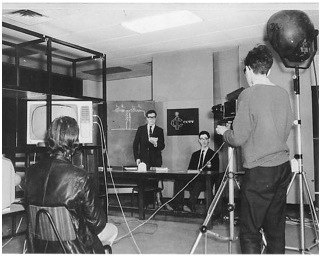
20 Minute talks taking place in 1967

STOIC’s origins are with the Electrical Engineering Department (who owned and ran the original TV Studio) in  January 1969, after being formed following a suggestion from Sinclair Goodlad. The initial idea was to help operate the cameras for the departments “20 minute talks” that ran each Wednesday afternoon (see photo from 1967). This would give them something positive to do and would also give them experience prior to the setting up of an official union club and by October 1969 this had happened. The first experimental news programme was recorded on 17 February 1970 and was called “IC Newsreel”. Now 40 years later, this programme still exists on videotape and an extract from that programme can be seen in the 10th anniversary recording at the end of this current blog entry. In it you’ll see Professor John Brown, then head of the electrical engineering department speaking about the death of Lord Jackson the Pro-Rector. John Brown being a relative of Prime Minister Gordon Brown.
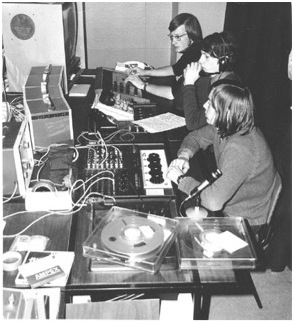
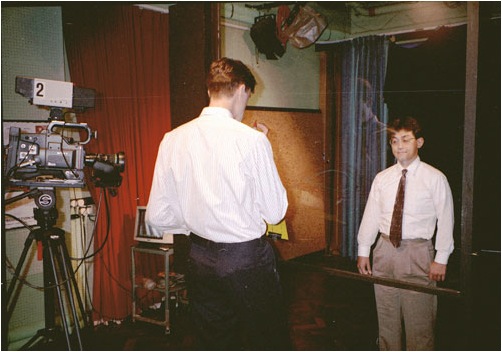
STOIC in the original TV Studio in 1971

For the first and second programmes the technology limited the students to 1/ recording only within the confines of the studio and 2/ recording in one go, that is, without any form of editing. Because of this, showing things outside of the studio was clearly not possible, but there was a simple solution by using 8mm home movie film. STOIC shot short items on film and edited them into a suitable order for use in the programme. The films were silent and frequently in black and white, although some do exist in colour (the videod programmes were black and white). Although a small collection of those 8mm films are still around, the news programmes that they were shot for have long since been erased. This was due to the fact that videotapes cost around £30 at that time. So, all these years later we are still able to see short film clips of events and that’s what we’re going to do now.

This is a film clip from the early 1970’s and may well be featured in one of the first two programmes still on tape. But here it is in its original 8mm film version as used in the programme. It’s a student union meeting being run by the union president Piers Corbyn and we’re lucky that Lord Penney, the Rector, was clearly addressing and answering questions from students. This 8mm cine film is interesting because, besides the videotape interview, this is the only other moving film record of Lord Penney at Imperial College. Remember this is silent and in black and white.

STOIC were well underway by the time of this next video from June 1971. It focuses on the fact that they were heavily involved with the camera operation for the student’s 20 minute talks in Electrical Engineering. A mock-up talk is given by a STOIC member, who was also in the department as a student. The video was made to get members to join in the October of that same year. It should be remembered that at this time almost no one would have had access to video cameras, let alone a videotape machine, so being in STOIC gave people that access. Some of the technology behind the scenes is shown to enthuse students to join. It’s all very basic and looks a bit faked, you’ll see some flashes between sections where the videotape machine was stopped and then restarted to allow sections to be recorded (no editing as such at that time).  Tim Dye, the chairman, appears at the end of the video to encourage people to join. This was made nearly 40 years ago so quality is poor, but it’s amazing that it has survived to this day!
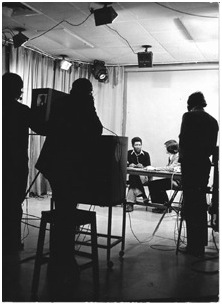
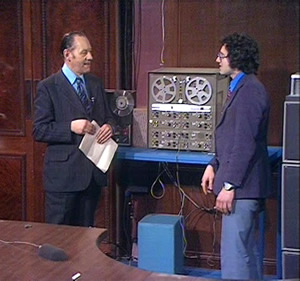
Trevor Philips talking to Desmond King 1970’s

This next photo is interesting as it features the former Student’s Union President (1975-1977) Trevor Phillips being interviewed by Desmond King. This would have been for one of the weekly news programmes. Trevor went on to work (briefly) in TV himself with LWT, so perhaps these early outings were his first step towards that. Trevor will also feature in other videos in future posts on STOIC. He is (as of Feb 2010) chair of the Equality and Human Rights Commission. At this time, all main events were still studio bound, but things would soon change. 8mm cine film would soon be a thing of the past for their news programme coverage. Skipping forward some 8 years STOIC had bought their own portable videocamera recording system. This allowed them to go outside and record the type of events that students get involved with.

Morphy Day was one such event to be covered annually. Originally, on the day each year, just a cup was presented for rowing, but in later years on Morphy  Day the towpath at Putney was also the scene for battles between supporters of the various teams. All sorts of waste food matter, flour and dead fish were hurled at each other. This was just too good an opportunity to miss and so we can now see Morphy Day from 1979, but we can’t smell it thank goodness. This event no longer happens and is therefore yet another unique record of college life and its traditions from years past.
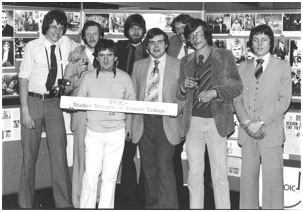
Past STOIC chairman at the 10th Anniversary in 1980

Finally, to end this first look at STOIC we have a video made to celebrate the first ten years of its operation. Because students will come and go in a natural cycle of time I was the only person who knew the history and the people involved since 1969. Although the formation became official in 1969, the first 10 years were actually celebrated in February 1980, this was to coincide with the first programme being made in February 1970. In conjunction with the current membership we made a video that celebrated all that had happened since the beginning.

Indeed a lot has happened during the time, going from black and white into colour was an obvious improvement and being able to edit was a major leap forward. A party was organised and every STOIC chairman to date attended (above photo). Jumping forward some 30 years perhaps an updated version is now long overdue? I hope those who remember watching STOIC’s programmes, or those who were members, enjoyed this first look back into their archives. So it’s another Happy Birthday to STOIC, 40 years old this very month!

Colin Grimshaw February 2010
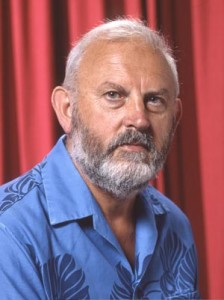
Research and Innovation: Bob Spence

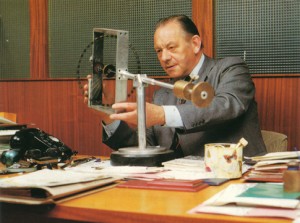
Bob Spence

Few people have used the idea of videotape better that Professor Bob (Robert) Spence. Bob joined the staff of Imperial in the 1960’s and is now Professor Emeritus in EEED. His field of work has ranged from engineering design to human-computer interaction and along the way is credited with the invention of the first ‘focus+context’ technique, the Bifocal Display (aka Fisheye lens). You’ll be seeing the Bifocal Display idea in a while.

My first encounter with Bob was way back in 1975 when we recorded a live demonstration of the computer language APL (A Programming Language (link above). This is the oldest surviving teaching videotape we have and was made without the ability to edit and in glorious black and white. However, it does feature a novelty at the time of the recording, that of split screen. This was shot in our TV studio ‘number one’ located then in the Electrical Engineering building.

In June 1979 Bob’s interests were in the area of electronic circuit design. With colleagues, he had devised MINNIE allowing a circuit designer to describe a circuit by drawing it on a screen. Using a ‘light pen’ to interact with the screen, circuits could be created and modified.

The most interesting artifacts (as Bob calls them) were the “on screen pocket calculator” (1979) and the “count-down clock” indicating the process time.  The on-screen calculator is thought to be the first in the World and both these functions are now common place. Bob frequently reminds me of the fact that we were about to move into colour TV (1979) and how he halted the removal and replacement of the computer running MIINIE so we could shoot the video in colour. Here’s the end result from June 1979 (link above) and you can see the calculator at 5min 30secs into the video.

By 1980 the idea of ‘focus+content’ had been identified and a solution called the Bifocal Display created, well in mock-up form anyway. Bob wanted to create a video to show this and other concepts to a wider audience. Again, videotape was a solution to this. So, in the week we all finished for Christmas in 1980 we shot a video which is now credited as being the first ever ‘envisionment video’, “Office of the Professional”. For the time, this was a most complicated video to make. Although with converting  into colour we had gained the ability to edit, this was like no other video we had made before. Scenarios in an office, external elements and multiple video screens -all showing content- only added to the overall complication.

The office desk was made mostly of cardboard and felt. The buttons seen being pressed were not bright enough to be seen by our early colour camera, so higher wattage bulbs were inserted. This made the buttons so hot you could hardly touch them, let alone press them! The variable ‘zoom’ control on the monitor did nothing and was made of cardboard.  The display on the screen was actually running from a videorecorder  and Bob had to synchronise his hand movements to the pre-recorded tape. In one scene we needed two screens showing information and therefore need two playback machines, plus the machine recording the output from the camera, so three video recorders were all running at the same time. In one sequence you’ll see ‘pointing’ at the wall and the phrase ‘here’ being used. Bob tells me that this concept is not too far away. Bill Buxton in his 2007 book ‘Sketching user experiences’ is quoted as saying, in reference to the video, “….is the first example of envisionment videos that I am aware of….” and “….remarkable for its insights…and two years before the launch of the Apple Macintosh.” And finally he says of the video “…I have a lot of respect for those who made it.” Bill Buxton’s book is prefaced by Bill Gates. Once again, a small piece of history is recorded in our archive. Oh and the standing joke between Bob and myself is that one or the other of use will have to say the magic word “here” during a conversation. Most of this is very obvious in the 1980 “Office of the Professional” (link above).

Not wanting to make a video any less complicated or involved than previous ones, Bob came up with a gem of an idea in 1994. “Translations” was once again an envisionment video (link above). It shows a dinner party taking place in the year 2020AD and hosted by an eminent engineer, for other engineers who describe, for the benefit of a journalist, how they practice design. The message was concerned with human-to-human communication facilitated by computer. The video took many weeks to shoot as there were several locations used: Silwood Park where the main dinner party took place; 170 Queens Gate in the Rectors flat and the TV Studio. One fascinating thing to look out for are the use of PIG’s, Personal Information Gatherers. See if the concept reminds you of Bluetooth devices, common place today. Also, during the dinner party the idea of a worktable, able to sense what you were doing was suggested. Microsoft has just demonstrated one! One final thing before you watch the video. For those who know me, try and spot where I re-voiced the sound for one of the people in the video, oh and I’m not saying ‘here’ either. Bob Spence plays the butler in the video “Translations: Engineering Design 2020AD”

Recording a sequence in “Translations”

My thanks go to Bob Spence for the many opportunities to make some great envisionment videos over the years. It seemed that the insights Bob had into the way we interact with machines, was well suited to video as way to show those ideas off and to communicate them to many other people.

Professor Robert Spence, passed away on Friday 20th September 2024, at the age of 91.

Colin Grimshaw January 2010

Research and Innovation: Eric Laithwaite

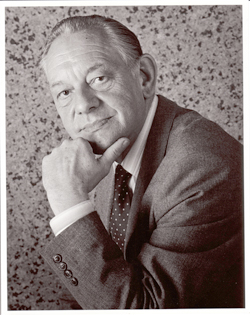
For this second blog we’re going to look at an inventor, innovator and communicator of science on TV and in the classroom. Eric Laithwaite (1921-1997) came to Imperial College in 1964 as Professor of Heavy Electrical Engineering.  His specialist work was on Linear Induction Motors. Prior to his arrival at Imperial, he had appeared on TV many times, so he was no novice to the whole process of making both TV programmes and, as was the case with ICI’s Millbank Films, science learning materials for schools. He made a whole series of films for ICI such as “Motors Big and Small”; “Shaping things to come” and “The Circle of Magnetism”.

He was also the first person to present  an entire Royal Institution Christmas Lecture series on TV, that was on BBC2 in 1966. Since that time every RI Christmas lecture has been televised. Once again though he made history by being the only person to present a Christmas lecture a second time and that happened in 1974. It was, however, not simply a repeat of the one in 1966!

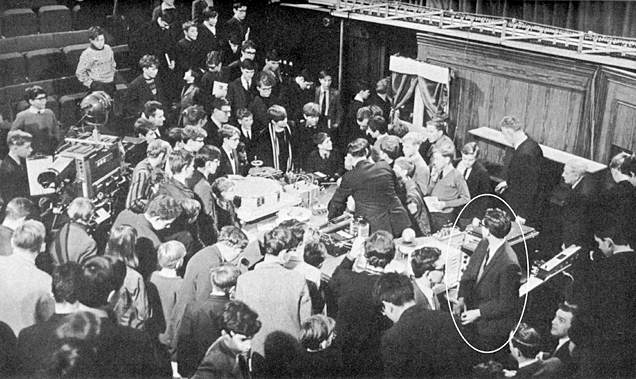
Colin Grimshaw circled at the RI 1966

How do I know all this you may ask? Well, I’m biased because for a short period of time I worked with him and was present during the recordings of the 1966 Christmas lectures at the Royal Institution. If anyone still has his book from the series “The Engineer in Wonderland” you’ll see me in a photo on page 155.

By the time of the 1974 series “Engineer through the looking-glass” I had moved on to do video production. So I was surprised to receive a visit from Eric Laithwaite in the early summer of 1974. He wanted to chat about ideas for talking backwards. Programme number 3 was to be “Jam yesterday and jam tomorrow” and he wanted to see what we could come up with for the reversing of time and speech.

At the Christmas Lectures 1974/75

I must have come up with a good idea because when he heard what I’d done with “Merry Christmas and a Happy New Year” (backwards of course) he said “Right I’d like you to present that during the lecture”.  My credit in his book of the series says “…Colin appeared ‘officially’ in the second lecture taking over part of the lecture in effect”.  Because of media interest in the advanced publicity for the 1974 series both myself and Eric Laithwaite were interviewed on BBC Radio about the speaking backwards idea. It was only recently that I had the opportunity to get hold of a DVD copy of the original videotape still held in the BBC archives. The quality is still amazingly good too.

Armed with all of this background knowledge, in 1980 I recorded an archival interview (link above) with him in his lab office in Electrical Engineering. Part of this interview was used in a special IEEE memorial lecture given by his colleague Barry Owen.

Eric Laithwaite’s work continued with linear motors of all types. The ‘Magnetic River” was a short video (link above) I shot for him in March 1984. It features his now familiar model of a levitated and propelled train by means of magnetic induction and was the very last video I made with him. A few years earlier this same linear motor had appeared in the James Bond film “The Spy who loved me”. It was another of “Q’s” gadgets that was demonstrated to Bond. I just happened to be going to Pinewood Studios and took the demo film to Eon Productions for them to decide whether  to use it or not in the production. They did use it and Eric Laithwaite’s technician Cliff Johnson was seen operating the Magnetic River in the actual Bond film. Buy the DVD of the film to see what I mean.

As well as its uses for tracked transport the ‘Mag River’ had other potential. In this 1980 example (link above) its use as a metal sorter, sorting out aluminium from other scrap materials, is being demonstrated. Materials were painted various colours to show what was being separated.

A video I shot with Eric Laithwaite in May 1983 (link above) was a demo for an American film company who were considering making the “Silver Surfer”. The idea was to levitate someone on a huge aluminium sheet. As you’ll see from this video, it was a rather daunting task and as far as I recall, never happened. All the humming is coming from the huge electromagnetic field coming from the coils.

His research in later years into Gyroscopes was, and still is, a topic of much discussion within the scientific community. Here, he demonstrates the principles of a gyro using a rather large and heavy wheel (link above). It’s spun up to speed with a normal household drill! We recorded this video in our TV Studio in May 1983  and needless to say, I stayed well back from both him and the wheel! It was always ‘fun’ working with Eric Laithwaite and I recall him sliding off a chair in the studio as he laughed so much when we tried speaking backwards into a taperecorder. He once said to me that when a job is no longer fun, it’s not worth continuing with it. The last time that I spoke with Eric Laithwaite was when he was telling me about the concept of a linear motor launcher for NASA rockets/vehicles, I never saw his again…

Colin Grimshaw December 2009